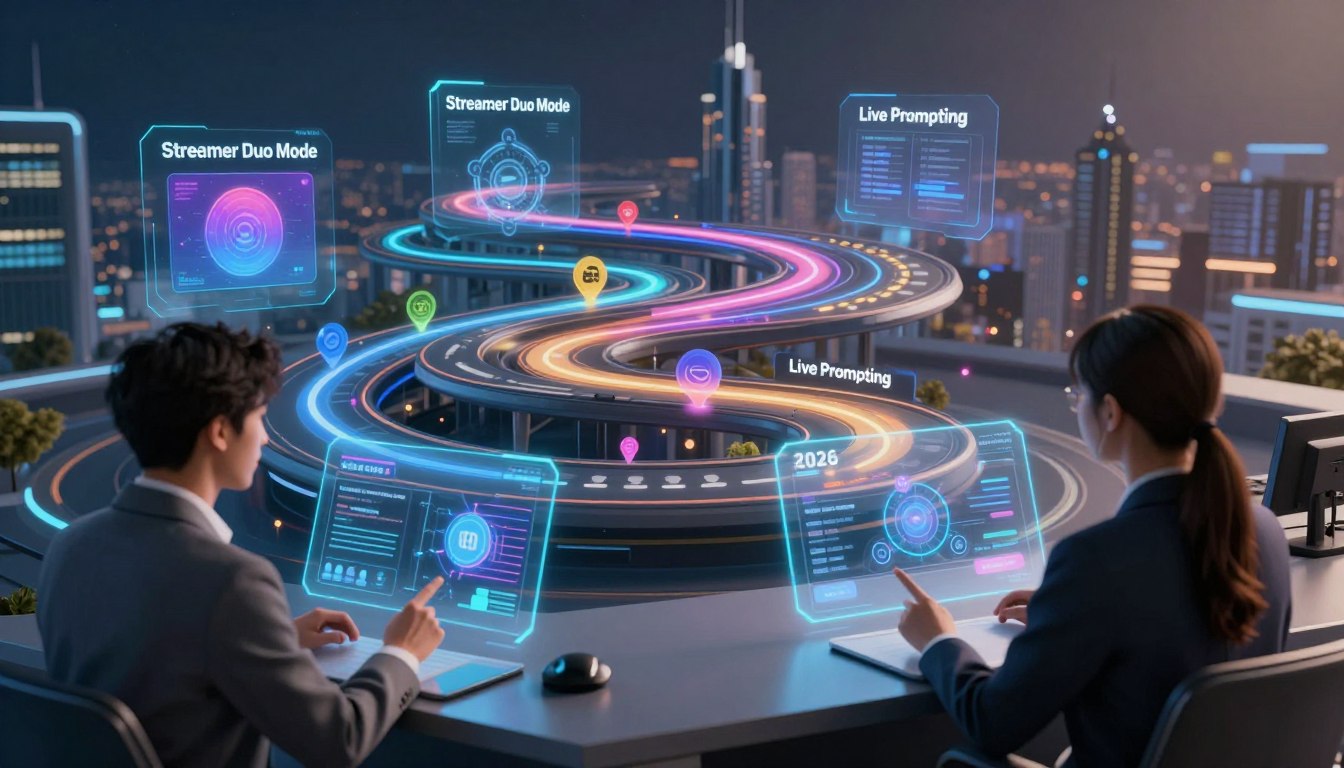
2026 Roadmap: Streamer Duo Mode, VR Intake & Live Prompting
Ever thought about how your favorite shows will change with 1,000 times more computing power by 2028? The digital world is changing fast. This pokimane ai roadmap shows how creators will soon change how we watch.
Looking ahead to roadmap 2026, we see big changes in how we make and share content. You’re on the verge of a new era where advanced technology is part of your daily work. Knowing about these upcoming tools is key to staying ahead in a busy market.
This feature preview shows off new tools to improve your show’s quality and how viewers interact. By using these new features, you can make your stream more engaging for your audience.
Key Takeaways
- Computing power is set to increase 1,000 times by 2028, changing streaming a lot.
- The 2026 plan includes Streamer Duo Mode for better teamwork.
- VR intake will make broadcasts more immersive and interactive.
- Live prompting tools will help creators keep the audience engaged.
- Using these new techs early will keep you ahead of trends.
Understanding the Pokimane AI Roadmap
You’re at the start of a big change in live content. The pokimane ai roadmap is a guide for this shift. It moves from simple automation to interactive virtual worlds.
Evolution of AI in the Streaming Landscape
The streaming world is seeing a huge jump in computing power. Breakthroughs like Google’s scaling to a million chips in one cluster are key. They support these big steps forward.
This tech lets AI do complex tasks in real-time. It’s no longer just about simple chat moderation. Now, AI can join in and help with your show.
Key Milestones for the 2026 Development Cycle
The pokimane ai roadmap focuses on making these tools easy for solo streamers. It aims to make advanced tech accessible. This means easier entry for creators.
The table below shows how these features will improve by 2026:
| Feature Category | Legacy Systems | 2026 AI Integration |
|---|---|---|
| Audience Interaction | Static Chatbots | Dynamic AI Personalities |
| Content Creation | Manual Clipping | Automated Real-Time Editing |
| Processing Power | Local GPU Only | Cloud-Scale TPU Clusters |
| Engagement Depth | Surface Level | Immersive VR Perception |
By following the pokimane ai roadmap, you can give viewers a more personalized and interactive experience. Being ready for these updates keeps your content fresh in a digital world that’s getting more automated.
Preparing Your Streaming Setup for 2026 Upgrades
To stay ahead, make sure your gear meets the roadmap 2026 standards. The shift to AI-driven features means your equipment needs to handle more data. Proactive preparation keeps your broadcasts top-notch.
Assessing Current Hardware Compatibility
The streaming world is evolving fast, thanks to cloud computing. For example, Anthropic is investing $1 billion in Amazon for AI model training. Your local machine connects you to these powerful cloud resources.
Review your GPU and CPU specs to see if they’re ready for AI tasks. Bottlenecks often occur when old hardware can’t keep up with data streams. This can lead to dropped frames or latency in live streams.
Updating Firmware and Software Dependencies
Keeping your software up to date is as crucial as your hardware. Old drivers or conflicting processes can block new features. A full system audit is key to your roadmap 2026 plan.
Make sure your OS, streaming software, and drivers are current. Regular updates bring important patches that improve communication with AI servers. Managing these now helps you avoid issues with new tools.
Mastering Streamer Duo Mode for Collaborative Content
This feature preview shows how AI can make your live shows more exciting. By adding AI personalities to your streams, you can talk to your viewers and co-streamers at the same time.
“True collaboration in the digital age is not just about sharing a screen; it is about synchronizing the very essence of your creative intent across multiple inputs.”
How to Sync AI Personalities with Co-Streamers
To sync your AI co-star, you need a strong connection. This connection keeps the AI’s personality consistent. It’s important for the AI to understand both your voice and your co-host’s.
Using the BitFire BFTX transport protocol is key. It makes sure your AI personality stays in sync with the live action. This gives your viewers a seamless experience.
Managing Dual-Input Data Streams
Dealing with two data streams needs careful planning. You must focus on your co-streamer’s audio and video while the AI works in the background.
This balance keeps your broadcast smooth. Successful streamers often use special hardware to handle the extra work of processing two streams.
Synchronizing Audio Latency for Duo Interactions
Audio lag can ruin live conversations. The BFTX protocol fixes this with sub-half-second latency.
This precision lets you chat naturally with your AI co-star. Consistency in audio timing keeps your audience hooked and engaged.
Setting Up VR Intake for Immersive Audience Interaction
You can now connect the real world with virtual reality. By using upcoming tools, you make a stronger bond with your viewers. This is something traditional streaming can’t do.
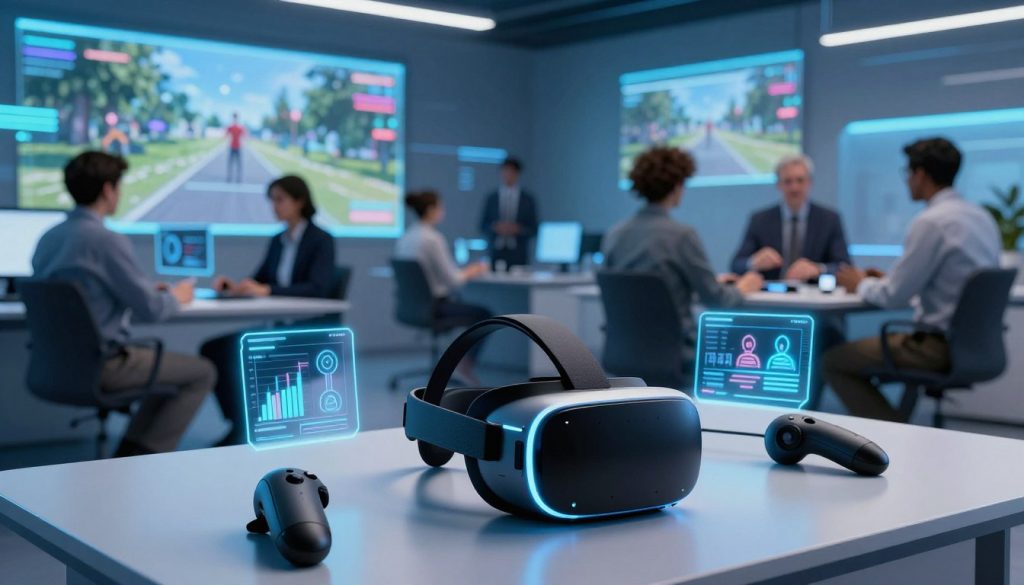
Integrating VR Headsets with AI Perception Modules
The heart of an immersive broadcast is how your hardware talks to your software. You need to link your VR headset to AI perception modules. This lets your digital world know you’re there in real-time.
This setup lets the AI follow your head and eyes. It turns your movements into dynamic visual feedback. When everything is synced, the AI acts like an extra part of you, reacting to your world.
Mapping Physical Movements to Virtual AI Responses
After setting up your hardware, you must connect your actions to virtual triggers. This makes sure your virtual self or world moves with high precision when you do.
Good mapping needs fast data flow between your headset and AI. By adjusting these settings, you make your physical and virtual performances blend smoothly.
Calibrating Spatial Awareness for Live Environments
Keeping a professional look means calibrating your space well. Use Canon’s Multi-Camera Orchestration (MCO) to sync multiple PTZ sub-cameras with your main camera.
This setup gives the AI a comprehensive view of your actions. It helps avoid mistakes during live shows. Proper calibration is key for these upcoming tools to work right, keeping your audience fully engaged.
Implementing Live Prompting for Real-Time AI Assistance
Adding live prompting to your broadcast workflow changes how you talk to your audience. With upcoming tools, you get instant ideas to make your commentary better. This makes your content flow smoothly, just like Anthropic’s Claude Design lets users build prototypes in one chat.
Configuring Dynamic Prompt Injection During Broadcasts
To start, set up your system to take dynamic inputs without stopping your gameplay. Use a secondary monitor or an overlay to show AI prompts right in your view. Precision is key to keep the info relevant to the game.
“The future of streaming lies in the seamless collaboration between human creativity and machine intelligence, where AI acts as a catalyst for deeper audience connection.”
Balancing Automated Responses with Human Commentary
It’s important to mix machine text with your own voice to stay true to yourself. Think of the AI as a co-pilot, not a replacement for your personality. Use AI responses as a starting point for your own thoughts, not just reading them out.
| Feature | Automation Level | Human Oversight |
|---|---|---|
| Chat Moderation | High | Low |
| Commentary Prompts | Medium | High |
| Technical Alerts | High | Medium |
Customizing AI Tone and Personality Profiles
Your brand’s identity is tied to how your digital assistant talks to viewers. You can tweak the personality settings to fit your vibe, whether it’s professional, funny, or energetic. By fine-tuning these profiles, all upcoming tools will feel like a natural part of your channel.
Optimizing Hardware Requirements for New AI Features
Building a strong foundation for your broadcast starts with knowing the specific hardware needs of the roadmap 2026. As you add complex AI tools, your system must handle more work without losing frame rates or stream stability.
GPU and VRAM Recommendations for Local Processing
Local processing is key for a smooth streaming experience. You need a GPU with at least 12GB of VRAM for smooth AI tasks during intense broadcasts.
High-end graphics cards are crucial for rendering AI-driven overlays and interactive elements at the same time. If you plan to run many AI modules, consider upgrading to 16GB or 24GB of VRAM to avoid performance issues.
Network Bandwidth Needs for Cloud-Based AI Tasks
While local power is important, many advanced features need cloud-based AI processing. You need a fast, stable internet connection for low latency when talking to remote servers.
Choosing the right cloud provider can save you money. For example, Oracle Cloud Infrastructure (OCI) can be up to 50% cheaper for compute and 80% cheaper for networking compared to AWS or Google Cloud.
| Cloud Provider | Compute Cost | Networking Cost | Best For |
|---|---|---|---|
| Oracle Cloud (OCI) | Low | Very Low | Budget-Conscious Creators |
| AWS | Standard | Standard | Enterprise Integration |
| Google Cloud | Standard | Standard | Data Analytics |
By choosing cost-effective infrastructure, you can spend more on high-performance local hardware. This balanced approach meets the roadmap 2026 needs while keeping costs down.
Configuring Software Integration for Seamless Performance
Connecting your AI modules to your broadcast software is key for a glitch-free stream. When you mix complex tools with your live show, how they talk to each other matters a lot. Getting this right means your viewers get a smooth, pro-looking stream without any hiccups.
API Connectivity with OBS and Streamlabs
First, you need strong API connectivity for a smooth workflow. By linking your AI tools to OBS or Streamlabs, you get real-time data exchange. This connection is like the brain of your show, sending commands to your visuals fast.
To make this work, keep your plugins up to date for your streaming software. Consistency in API settings stops errors that can mess up your stream. Make sure your authentication tokens are safe and set up right in your software’s settings.
Managing Resource Allocation for Background AI Processes
Streaming well means managing your computer’s resources well. You can’t let your AI tools take too much CPU power from your main stream. If they do, you might see stuttering or big delays.
Tools like the Grass Valley ACE-3901-GRID app can really help your workflow. It lets you share media fast and low-latency, keeping your computer from getting too busy. This way, you can keep your stream smooth even when things get intense.
Watch your system’s usage with task managers to spot any slowdowns. Prioritizing your streaming software in your OS settings keeps your stream top priority. This careful planning ensures your stream runs smoothly while your AI tools work quietly.
Best Practices for Maintaining Authenticity with AI Tools
Technology should help your creative vision, not hide it. Your unique voice is your most valuable asset. AI can do the hard work, letting you focus on connecting with your audience.

Strategies for Blending AI Assistance with Personal Branding
You can use AI for complex tasks without losing your brand. Like the 4 million users of OpenAI’s Codex, you can automate tasks. This efficiency lets you engage more with your chat and react to events in real-time.
To keep your brand, make sure AI outputs match your tone. If your stream is funny, set AI prompts to match. Treating these tools as productivity enhancers keeps your personality in every broadcast.
Avoiding Over-Reliance on Automated Content Generation
Too much automation can make your content feel robotic. If your stream seems predictable, viewers might lose interest. The human element should always drive your stream’s story.
Here’s a table to help balance your workflow:
| Feature Category | AI-Assisted Approach | Fully Automated Risk |
|---|---|---|
| Live Commentary | AI suggests talking points | AI generates all dialogue |
| Technical Setup | AI optimizes OBS settings | AI controls all stream logic |
| Viewer Interaction | AI filters and highlights chats | AI replies to all messages |
| Content Strategy | AI analyzes viewer trends | AI dictates all content choices |
Your audience wants to see you, not a machine. Use AI to support your creativity, but always control your content. This way, your channel can grow while staying true to your vision.
Troubleshooting Common Issues During Feature Rollouts
Even the most advanced setups can run into problems when introducing a new feature preview. Technical issues are a normal part of growing for any streamer. By spotting these problems early, you keep your stream professional and fun.
Think of your streaming setup as a pro broadcast station. Just like the Appear X Platform reduces space needs for satellite signals, your network should handle high-bandwidth data well. When you see a feature preview glitch, check your connection first.
Resolving Sync Errors in Duo Mode
Sync errors happen when data packets don’t match up between you and your co-streamer. This is often due to uneven upload speeds or network jitter. Use a wired Ethernet connection to reduce these issues in team sessions.
If audio or video is still off, tweak your software buffer settings. A bit more buffer can help your system handle streams better. Make sure both you and your co-streamer are using the same integration tool version to avoid compatibility problems.
Fixing VR Tracking Drift and Latency Spikes
VR tracking drift can occur when sensors lose calibration or get affected by light. Make sure your play area is well-lit but without glare on your tracking gear. Recalibrate your sensors before each broadcast to avoid movement issues during the stream.
Latency spikes often come from other apps using your GPU. Watch your system’s performance during a feature preview to find resource hogs. Closing unused apps can help keep your VR interactions smooth and responsive.
Scaling Your Channel Growth Using Advanced AI Analytics
Today’s streamers use upcoming tools to turn data into growth plans. They look beyond just view counts to find what keeps viewers hooked. This approach helps them fine-tune their content based on instant feedback.
Leveraging AI Insights to Predict Viewer Trends
Predictive analytics let you guess what viewers want before they ask. For example, EVS’s LSM-VIA Zoom uses AI-driven object recognition to focus on key moments in real time. This makes sure your viewers always see the most exciting parts, even in chaotic gameplay.
These systems analyze past data to suggest the best times to go live or switch games. By optimizing your schedule to match when viewers are most active, you can get more eyes on your content. This turns your channel into a professional media outlet.
“Data-driven content is not about losing your creative soul; it is about providing the best possible experience for your community through informed decisions.”
Automating Clip Generation and Social Media Distribution
Handling your channel on different platforms can be overwhelming. Luckily, upcoming tools now automate the process of creating and sharing clips on social media. They pick out the most exciting parts and format them for platforms like TikTok, Instagram, and YouTube Shorts.
This automation saves you a lot of time each week. You can focus on your live streams while the software takes care of sharing your content. Here’s how these tools compare to doing it all by hand.
| Feature | Manual Workflow | AI-Driven Workflow |
|---|---|---|
| Clip Selection | Time-consuming review | Instant highlight detection |
| Video Reframing | Static camera angles | Dynamic object tracking |
| Social Posting | Manual upload/tagging | Automated cross-platform sync |
| Trend Analysis | Guesswork | Predictive modeling |
By using these systems, your brand stays active even when you’re not. Consistency is the key to growth, and automation makes it possible. Adopting these technologies will keep you competitive in a crowded online world.
Safety and Ethical Considerations for AI-Driven Streaming
Using advanced AI in your streaming needs a strong focus on safety and ethical standards. As you use new tools to improve your shows, make sure your online space is safe for viewers. Keeping these values in mind helps you earn and keep your audience’s trust, even with today’s tech challenges.
Implementing Content Filters and Moderation Protocols
Automated tools can sometimes act unexpectedly, making strong content moderation key. Set up strict filters to stop AI from sharing bad or harmful content live. Check these filters often to keep up with your chat culture’s changes.
Think about using a mix of human checks and AI alerts. This hybrid strategy lets AI help fast while keeping a human ready to stop things. Being ahead of issues helps avoid big PR problems.
Protecting Personal Data in AI-Integrated Workflows
Keeping your personal data safe is crucial, especially with AI getting smarter. Reports from the White House and big tech companies show the dangers of AI theft. These global issues remind us to make our local setups very secure.
Always put data encryption first and choose software that cares about privacy. Don’t share personal info with cloud AI without clear data policies. Treating your AI setup like your bank info keeps your brand and identity safe from hackers.
Conclusion
The 2026 roadmap for artificial intelligence in streaming opens up big chances for creators. By learning to use tools like Streamer Duo Mode, VR intake, and live prompting, you can make your shows look and sound like a pro’s. This will take your production to the next level.
Technology is key to your growth. But remember, your personal brand and unique voice are the most important things for your success. People connect with you because of who you are, not just what you do.
Keep up with the latest from Twitch and YouTube. Always act with ethics as you try out these new tools. Being true to yourself will shape the future of your streaming career.
Talk to your audience to see how these tools change your shows. Share your experiences with other creators to build a community. Taking these steps today is the start of your exciting journey into the future of interactive content.
FAQ
What is the primary focus of the roadmap 2026 for Pokimane AI technologies?
The 2026 roadmap focuses on making advanced AI tools available to creators. It uses big tech like Google’s million-chip clusters. These tools aim to create interactive virtual environments that improve your stream quality and interaction with viewers.
What can I expect from the feature preview of Streamer Duo Mode?
The Streamer Duo Mode preview shows how AI personalities can sync with human co-streamers. It uses advanced tech for almost instant delays. This lets you seamlessly work with AI co-stars on platforms like Twitch or YouTube.
How do upcoming tools like VR intake change the viewer experience?
VR intake tools let your movements trigger virtual responses in real-time. By using VR headsets with AI, you create an immersive space. This space reacts to your presence, offering a top-notch interactive experience.
What hardware do I need to run these new AI features effectively?
You’ll need to upgrade your GPU and VRAM for local processing. Companies like Anthropic are investing in cloud computing. Make sure your setup is compatible with these resources. Also, keep your firmware updated and network bandwidth high for a competitive edge in 2026.
Will these AI tools work with OBS and Streamlabs?
Yes, the tools will work with OBS and Streamlabs. They focus on API connectivity. This lets you manage resources to keep your broadcast stable and high-quality.
How can I maintain my brand’s authenticity while using AI assistance?
Use AI as a productivity tool, not a replacement. Customize AI profiles to match your voice. This way, you avoid losing your unique touch to automation.
How do these advancements help in scaling channel growth?
Advanced AI analytics help predict viewer trends. AI-driven object recognition automates clip generation and social media sharing. This lets you reach more people with less effort.
What safety measures are in place for AI-integrated workflows?
Safety is a top priority with advanced content filters and moderation. These tools protect your data and keep your community safe and trustworthy.
How do I troubleshoot technical issues like VR tracking drift or sync errors?
Fixing these issues requires a professional approach. Use IP-based signal processing to diagnose and solve problems. This ensures your stream stays professional and uninterrupted.